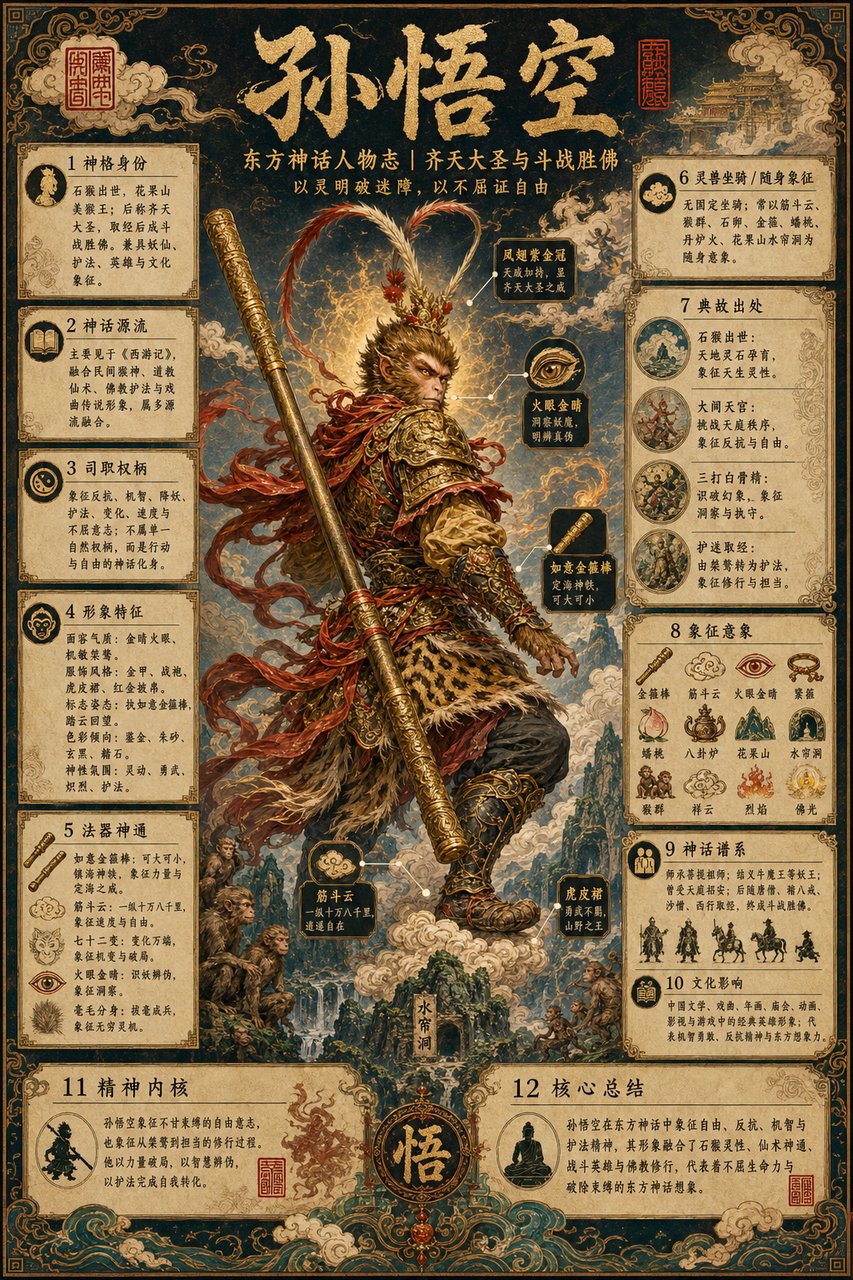
Please generate a vertical A4 "Oriental Mythological Figures" encyclopedia poster based on [Sun Wukong].

You are an oriental mythology visual designer, ancient book map designer and Chinese infographic designer. Please generate a character profile poster with complete content, unified vision, and the temperament of Eastern mythology based on the known image of [Character Name] in Eastern mythology, folklore, ancient books, opera, literature or traditional culture.

The most important principles:
All content must be centered around [Character Name], do not apply the general fairy template.
Character images, magical weapons, mounts, supernatural powers, allusions, symbols, and background scenes must all conform to the mythological setting of [Character Name].
If there are multiple legendary versions of this character, please use the most widely known version; if there are variations, you can briefly mark "different legendary versions" in the relevant section.
Do not forcibly make up uncertain information. You can write "There are many variations in folklore" or "There are few relevant records."
Do not use Nordic runes, Viking totems, Gothic borders, Western armor, European castles, Western fantasy devil horns, or cyberpunk elements.
The whole thing must be based on the aesthetics of Eastern mythology, rather than "Western fantasy characters changing into Chinese clothes."
Overall visual style:
The epic sense of oriental mythology combines the atlas of exotic animals in "The Classic of Mountains and Seas", Dunhuang murals, green landscapes, figure paintings of the Tang Dynasty, ancient paintings of the Song and Yuan Dynasties, bronze patterns, ancient book annotations and seal carving styles. The picture is solemn, mysterious, quaint, gorgeous but restrained.
Screen composition:

Vertical A4 poster, axially symmetrical layout. In the center is the main vision of the whole or half body of [Character Name], with a solemn posture, a sense of divinity and narrative. The character's clothing, hair crown, magic weapon, demeanor, spiritual beast, and background must conform to the legend of the character. There are information cards on the left and right sides, and a core summary at the bottom. It is surrounded by cloud and thunder patterns, back patterns, bronze patterns, auspicious cloud patterns, curly grass patterns, mountain and sea patterns, and seal-engraved seal-style borders.
Main title: "[Character name]"
Subtitle: "Chronicles of Eastern Mythical Figures|Generated based on the myths and legends of the characters"
Spiritual inscription at the top: Please automatically generate an elegant, concise and philosophical inscription based on the core spirit of [character name]. The inscription should reflect the values, life attitude or spiritual core behind the character, rather than explanatory text. Do not write disclaimers such as "not based on historical facts", "for reference only", "legendary version", etc. The word count is limited to 12-28 words, suitable for placement below the title. The inscription should be highly bound to the character, and do not use empty sentences such as "protect the common people" or "the road is boundless".

Please generate the following content sections:
[1. Godhead Identity] Explain the identity positioning of [Character Name] in the Eastern mythology system.
[2. Mythological origins] Explain which myths, ancient books, folklore, novels, operas or religious beliefs the character mainly comes from.
[3. Functional authority] Summarize the area that the character controls or symbolizes.
[4. Image characteristics] Describe the character’s typical appearance, clothing, demeanor, posture and visual temperament.
【5. Magical Weapons and Magical Powers】Display the character’s most representative magic weapons, weapons, spells, magical powers or abilities.
[6. Spiritual beast mounts/carrying symbols] If [character name] has a mount, spiritual beast, or companion creature, please show its name, form, and meaning. If there is no clear mount, please change it to "carrying symbol" or "related image". Don’t force each character to be a dragon, phoenix, crane or unicorn.
[7. Source of allusions] List 2-4 classic stories, legendary fragments or cultural allusions related to [Character Name]. Don't make up allusions that don't exist. If the versions are different, please mark "There are many different texts".
[8. Symbolic imagery] Refining the core visual symbols of the character. The symbol must be related to [character name].
[9. Mythological pedigree] Explain the relationship between the character and other mythical characters, camps, clans or systems. If the pedigree is unclear, please write "Legends of the pedigree vary."
[10. Cultural influence] Explain the influence of the character in folk customs, festivals, sacrifices, literature, opera, painting, temples, film and television, or modern culture.
[11. Spiritual core] Summarize the spirit symbolized by this character from the perspective of mythological narrative. Here we only analyze mythological images and do not infer the personalities of real characters.
[12. Core Summary] Use an elegant but easy-to-understand Chinese paragraph to summarize [Character Name]: "[Character Name] symbolizes... in Eastern mythology. Its image incorporates... and represents..."

Visual layout requirements:
Top: headline + subtitle + spiritual inscription.
Center: The main vision of the character, solemn and rich in details.
Column on the left: divine identity, mythological origin, authority, image characteristics, magic weapon and magical power.
Column on the right: Spiritual beast mounts/portable symbols, sources of allusions, symbolic images, mythological genealogy, and cultural influence.
Bottom: spiritual core + core summary.
Small icons, annotation lines, ancient book labels, scroll cards, bronze nameplates, cinnabar seals, and talisman patterns can be added.
Information cards should look like ancient book pages, jade slips, bronze plaques, scrolls or inscriptions, not like modern technology UI.

Material and pattern:
Rice paper texture, mineral pigments, gilt lines, cinnabar seals, ink blooming, bronze inscriptions, cloud and thunder patterns, fretboard patterns, auspicious cloud patterns, landscape patterns, and Dunhuang caisson patterns.

Color matching rules:
The oriental color scheme is automatically selected based on the attributes of [Character Name]. Flame/combat/protection: cinnabar, black, gilt, red. Moon/Water/Cold God: Dai Qing, Silver White, Moon White, Stone Blue. Mountains/Wood/Natural spirits: stone green, indigo, white jade, ocher. Emperor / Heaven / God: gilt, black, cinnabar, white jade. Demonic spirits/mountain and sea beasts: jet black, bronze green, dark gold, ocher red. Don’t use the same color scheme for all characters.

Text requirements:
The Chinese text must be clear and readable, the title must be grand, and the main text must be short and accurate. No garbled characters, pseudo-text, typos, overlapping or cropped text. If there is insufficient space, the main text will be compressed first, but all section titles will be retained.

Avoid:
Nordic runes, Viking style, Gothic borders, Western armor, European castles, fantasy game UI, cyberpunk, modern sense of technology, excessive darkness, random dragons and phoenixes, unrelated magic weapons, templated images of gods, allusions unrelated to [character name], and empty spiritual inscriptions.