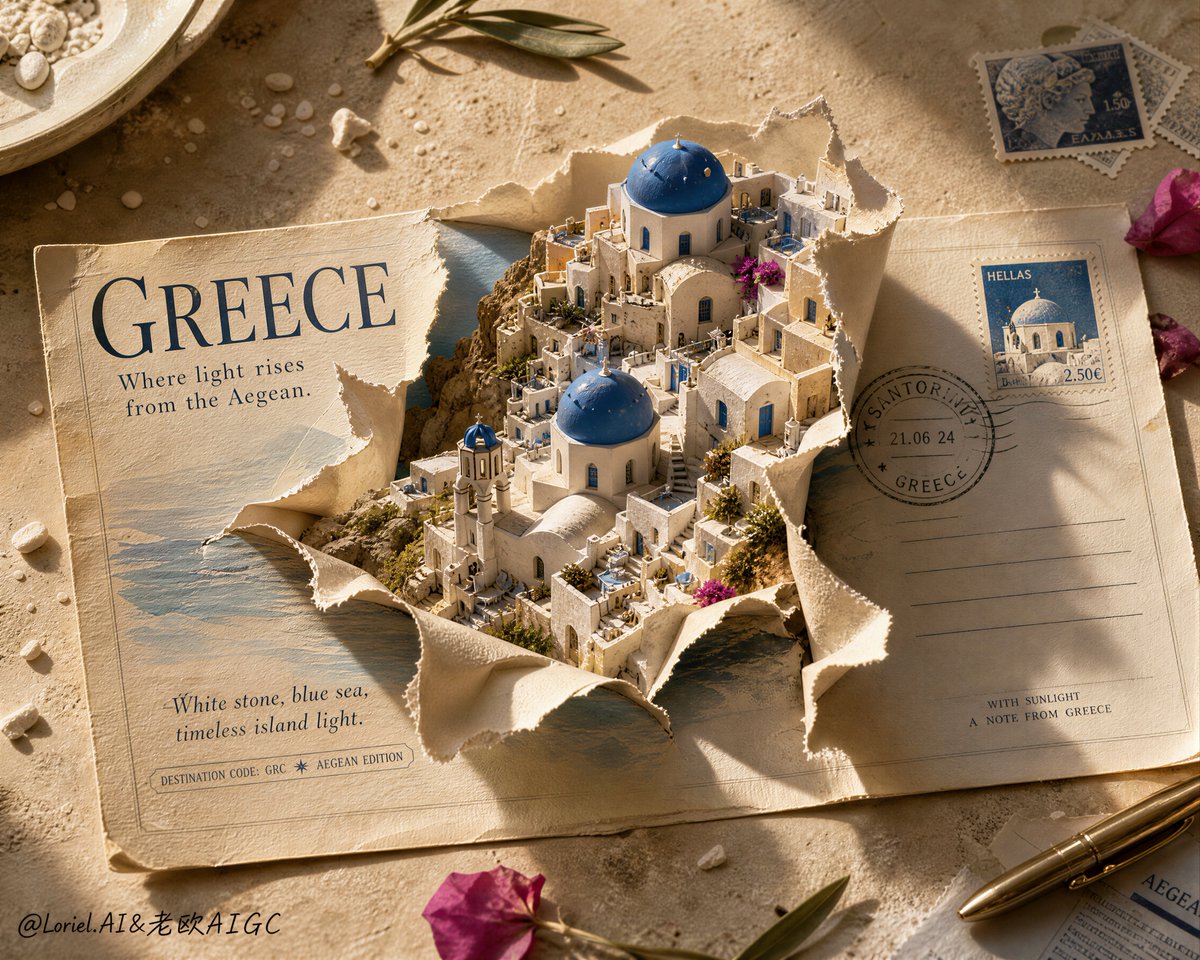
Create an ultra-premium tourism advertising poster for GREECE, built as a hyper-real tabletop postcard illusion where a vintage Greece travel postcard lies on a real desk and one single iconic Greek micro-landmark is bursting out from inside the postcard itself. The key visual must be unmistakable: the landscape does not sit on top of the postcard, it emerges from within it, forcing the paper upward, tearing through the printed surface, and pushing the card into soft curled folds. The final image must feel like a world-class destination campaign: collectible, tactile, luxurious, Mediterranean, and visually explosive while remaining completely believable.

Core concept:
The image should feel as if Greece is physically emerging from memory. The postcard has been pushed open from the inside by one rising landmark world. Use only one landmark, not a combination of multiple landmarks. The miniature scene must visibly burst through the paper plane, with the paper reacting naturally: swelling, splitting, lifting, curling, rolling, and folding back under pressure. The paper must never look stiff, flat, or cardboard-like. It must feel soft, fibrous, slightly aged, and genuinely forced outward by the miniature landscape.

Single landmark direction:
Use only Santorini cliffside architecture as the sole landmark identity.
Build the miniature around:
whitewashed stacked houses,
blue-domed chapels,
sunlit terraces,
tiny stairways,
cliffside balconies,
warm limestone ledges,
subtle bougainvillea accents,
small olive or dry Mediterranean plant touches,
and tiny human-scale details at believable miniature size.
Do not add Acropolis, Parthenon, or any second landmark. The whole identity must read instantly as Santorini, Greece.

Perspective logic:
This is critical.
The micro-landscape perspective must remain fully consistent with the tabletop and postcard viewing angle.
The camera should see the desk, postcard, torn opening, and miniature village from one unified slightly elevated three-quarter top view.
The miniature architecture must obey the same spatial logic as the postcard and desk surface:
same perspective direction,
same vanishing behavior,
same light direction,
same scale falloff.
The landmark should feel physically anchored inside the postcard opening, like a real dimensional model rising from the paper, not a separate object composited on top.

Burst-from-inside logic:
The landscape must clearly erupt from inside the postcard, not rest on the surface.
Show:
the postcard surface swelling upward before tearing,
the central rupture opening under real pressure,
Santorini architecture rising through the torn gap,
paper edges being pushed outward by the miniature volume,
the tallest white-blue structures lifting above the card with clear vertical dominance,
fine paper fragments and dust scattered outward,
and soft but convincing shadows under the raised miniature to prove height and separation.
The viewer must feel that the paper was broken open from below.

Paper curl behavior:
The torn paper must feel soft, flexible, and naturally curled, never rigid.
Use:
rolled paper lips,
soft backward curls,
bent flaps with organic tension,
partially coiled torn sections,
slight warping around the rupture,
layered paper thickness,
fiber-rich edges,
small creases,
and realistic paper memory in every lifted section.
Some parts of the postcard should curl into loose tubes or soft arcs where the tear has peeled back. The overall paper response must feel elegant, dynamic, and physically true.

Postcard design:
Use one elegant vintage Greece postcard resting on a premium tabletop, viewed from a refined slightly elevated three-quarter top angle.
The card should include tasteful travel-poster design:
main destination name,
stamp zone,
postmark area,
subtle guide lines,
and classic vintage-travel layout elements.
The card should feel beautiful even before rupture: slightly aged, sun-warmed, refined, and collectible.

Tabletop environment:
Place the postcard on a premium Mediterranean-style tabletop, warm and tactile but restrained.
Add only subtle supporting residue:
a few old postage stamps,
small white stone crumbs,
fine pale dust,
one or two dried olive leaves,
a very small number of bougainvillea petals,
light paper debris,
and perhaps the edge of a pen or ticket near the frame boundary.
These elements must remain secondary and elegant.

Material realism of the miniature:
The emerging Santorini world must feel like a museum-grade miniature:
sunlit plaster texture,
tiny blue dome glaze,
micro windows,
stone stair geometry,
mini railings,
cliff ledges,
architectural depth,
and precise scale logic.
It must feel handcrafted and monumental at once, never toy-like.

Lighting:
Use extremely refined Mediterranean daylight or soft golden editorial sunlight with delicate tonal transitions.
The light must reveal:
paper fibers,
soft curled paper tension,
dust and debris,
sunlit white walls,
blue dome highlights,
stone crumbs,
olive leaf dryness,
bougainvillea petal texture,
and the depth between postcard plane and rising miniature.
Shadows should be soft, dimensional, and breathable, never muddy or harsh.

Typography:
Use an English-led premium tourism typography system printed directly on the postcard.
Main English title:
“GREECE”
Optional supporting line:
“Where light rises from the Aegean.”
Optional smaller travel-note copy:
“White stone, blue sea, timeless island light.”
Typography should feel elegant, vintage-travel, and art-directed, integrated naturally into the postcard design. Include minimal official-style destination coding, but avoid clutter and cheap souvenir aesthetics.

Color direction:
Use a luxury Greece palette:
sunlit ivory white,
Aegean blue,
faded sky blue,
warm limestone beige,
olive green accents,
bougainvillea magenta,
honey-gold sunlight,
and restrained warm tabletop neutrals.
The palette must feel bright, Mediterranean, refined, and expensive, never postcard-cheap or oversaturated.

Mood:
sunlit, tactile, luxurious, collectible, Mediterranean, promotional, magical but believable, editorial, culturally rich, explosive, visually unforgettable

Rendering style:
ultra-premium Greece tourism poster, tabletop postcard burst illusion, soft curled torn paper under tension, 3D miniature Santorini village bursting from inside the postcard, unified tabletop perspective, old postage stamps, white stone crumbs, dried olive leaves, subtle bougainvillea petals, hyper-real still life, exquisite paper fibers and architectural textures, elegant English travel typography, 8k, world-class commercial image quality

Negative prompt:
two landmarks, multiple landmark mashup, landscape sitting on top of postcard, flat cutout landmark, mismatched perspective, stiff paper, hard cardboard tear, weak emergence effect, cartoon miniature, fake paper texture, low-detail architecture, unreadable typography, messy composition, plastic-looking buildings, flat lighting, oversaturated travel colors, poor tabletop realism, cluttered props, low-resolution travel ad