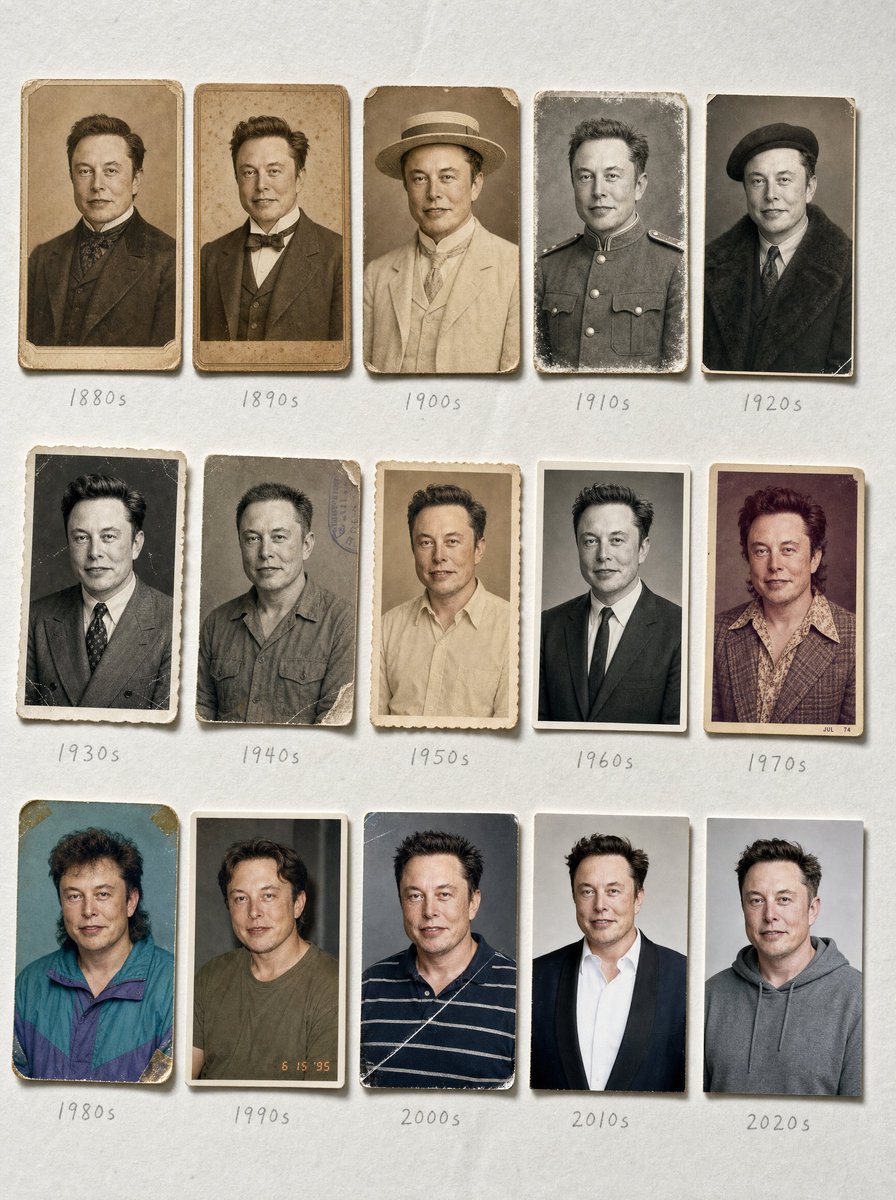
Overhead archival flat-lay: fifteen physical photographic prints of the same person, one per decade from the 1880s to the 2020s, laid out on a sheet of paper. Use the uploaded reference photo strictly as the facial identity source.

Surface: a single large sheet of heavy white cotton rag paper filling the frame, cold-press tooth clearly visible, faint fibre flecks, one soft crease running through the stock. Raking soft daylight from the upper left picks up the paper grain and lays a narrow soft shadow along the lower right edge of every print, so each print reads as a separate object resting on top of the sheet.

Camera: flat copy-stand view, lens perfectly perpendicular to the sheet, no perspective convergence, even coverage corner to corner.

Grid rule, absolute: the fifteen prints occupy five columns and three rows on a strict rectangular grid. All five prints in a row share one common horizontal centre line running straight across the sheet, and that line is exactly parallel to the top edge of the frame. All three prints in a column share one common vertical centre line, exactly parallel to the side edges of the frame. The three row lines are evenly spaced and the five column lines are evenly spaced. Every print is the same trim size and the same vertical portrait crop, with head and shoulders framed identically in all fifteen. Row spacing and column spacing stay constant across the whole sheet.

Tilt rule, absolute: each print is rotated only very slightly around its own centre, roughly one degree, and the direction of that rotation alternates from one print to the next along every row — a touch clockwise, then a touch anticlockwise, then clockwise again. The centre of every print stays exactly on its grid position; the rotation never shifts a print off that position. The result reads as a neatly arranged grid with a faint handmade looseness, never as a diagonal drift or a scattered pile. No print covers another.

Identity rule, absolute: bone structure, skull proportions, eye shape and spacing, nose bridge, jaw line and lip shape stay identical to the reference in all fifteen prints. Only wardrobe, hair, the photographic process and the physical print material change.

Presentation rule, absolute: read the reference photo once, decide how this person presents, and hold that single decision across all fifteen prints. Where a decade offers alternative garments below, choose the one that matches that decision and stay on that side of every alternative from the first print to the last. The same person, dressed consistently, ageing only through the eras.

Each print must be a photograph of a photograph — the emulsion, the paper stock, the border and the ageing belong to its decade, and the print itself carries handling: soft corners, fine surface scuffs, dust caught in the raking light.

Reading left to right, top row first:

1880s — dark frock coat with a high stiff collar, or a high-necked Victorian bodice with lace at the throat; hair oiled flat and short, or pinned up. Sepia albumen print mounted on thick cream cabinet card, bevelled edge, embossed studio rule, corners rubbed to the board underneath.

1890s — three-piece suit with bow tie and starched wing collar, or a dark high-collar dress with ruffle and brooch. Warm brown cabinet card, faint gold border line, foxing spots freckling the mount.

1900s — light colonial linen suit, or a pale cotton blouse; wide-brim straw hat either way. Matte collodion print on thin stock, warm brown, corners curled up off the sheet.

1910s — Edwardian military-cut tunic with epaulettes; hair clipped short at the sides, or swept up. Silver gelatin print, visible grain, mirrored silvering blooming along the edges, deckled trim.

1920s — soft-shouldered European tailoring, or a dark coat with fur collar and pearls; dark beret either way. Small matte gelatin contact print with a narrow white border, one corner creased....
1930s — double-breasted suit with wide lapels and pomaded hair, or a printed day dress with a bow at the neck and finger-waved hair. Glossy black-and-white print, deckled white border, hairline surface cracks.

1940s — utility workshirt with rolled sleeves, hair short or pulled back. Matte fibre print, hard tonal contrast, a purple date stamp bleeding through from the back, one torn corner.

1950s — pressed button-up shirt with a neat side part, or a soft yellow blouse with set curls; pastel backdrop either way. Warm-toned print with a scalloped white border, gentle overall fade.

1960s — narrow mod suit with a slim tie, or a dark dress with a white collar; sharp clean cut, or long straight hair. Glossy print with a clean white border, a thumb-print smudge in the gloss.

1970s — wide-collar shirt under a patterned jacket, or a floral wrap dress with a pendant; sideburns and volume on top, or long waved hair. Colour print gone magenta-warm with age, glossy, the month and year printed small in the white border.

1980s — teal and purple sport windbreaker; mullet, or permed volume. Glossy resin-coated print with rounded corners, cyan cast, sticky-tape residue at two corners.

1990s — plain olive oversized tee; curtained hair, or long and straight. Matte four-by-six lab print, flat on-camera light, an orange date burned into the lower right corner.

2000s — striped navy polo; short spiked hair, or long and parted. Minilab glossy print, borderless, blown flash hotspot, a scratch across the emulsion.

2010s — office shirt or black blazer; groomed short hair, or groomed long hair. Clean satin lab print, borderless, still sharp, faint dust only.

2020s — grey hoodie, cool light; cropped fade, or long and loose. Fresh inkjet print on smooth bright stock, no ageing, no border, edges perfectly crisp.

Under each print, written directly on the white sheet in soft graphite pencil, small and neat, one decade per print, sitting on a common baseline shared by all five labels in that row, exact spelling "1880s" "1890s" "1900s" "1910s" "1920s" "1930s" "1940s" "1950s" "1960s" "1970s" "1980s" "1990s" "2000s" "2010s" "2020s".

Rendering: pored, lived-in skin with real surface texture in every print, period-correct fabric weave and grooming, matching head size across all fifteen, photorealistic archival documentation.

Constraints: no drift in facial geometry between prints, no rows sliding diagonally across the sheet, no scattered or stacked arrangement, no text other than the fifteen pencil decade labels, no captions, no titles, no watermark, no logos, no drawn grid lines, no second person, no hands, no props on the sheet.