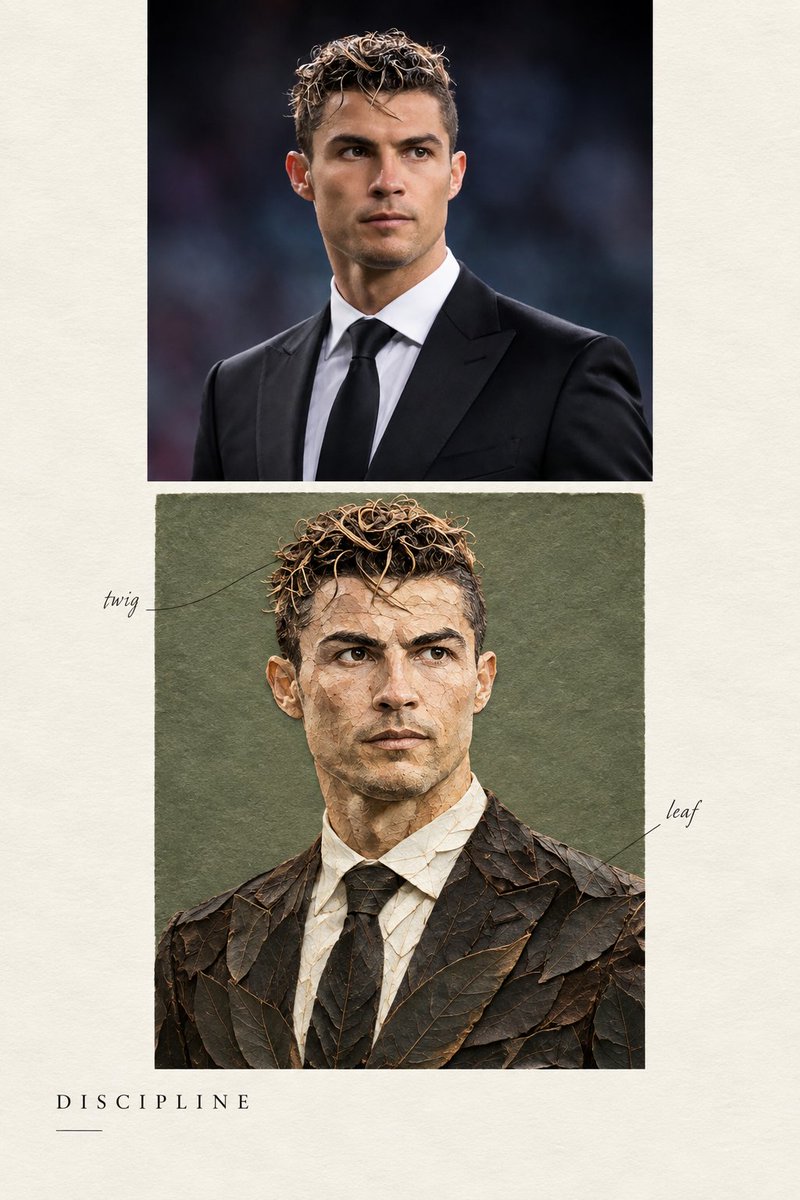
Create a vertical two-panel editorial artwork using the uploaded photograph as the exact visual reference.

TOP HALF — ORIGINAL PHOTO

Keep the top half as the real, unaltered photograph. Preserve the subject's identity, face, hair, clothing, pose, proportions and gesture. For animals, preserve coat colour, markings, ears, body shape, tail and action. If there is a person-and-animal pair, preserve their exact relationship and positioning.

Architecture and complex background details remain photographic only and must not be recreated in the lower half.

BOTTOM HALF — NATURAL-MATERIAL RECREATION

Rebuild the same subject, pose and silhouette as a sophisticated editorial illustration made entirely from real leaves, petals, twigs, grass stems, fruits, seeds, bark and dried leaves.

The natural materials must form the actual structure of the subject—not simply decorate a drawn figure.

Use their natural shapes intelligently:

- Hair from layered or curling leaves and grass.
- Clothing from overlapping leaves and petals.
- Arms and legs from twigs, grass stems or narrow leaves.
- Ears from naturally pointed leaves.
- Tails from curved twigs or slender plant material.
- Face and body from the natural contours, textures and edges of the materials.

Do not draw the subject's outline first and fill it with plants. Do not cut plants into geometric shapes or create a children's leaf-craft appearance. The same person, animal or pair from the photograph must remain immediately recognisable.

COMPOSITION & COLOUR

Place the natural-material subject within one simple rectangular colour field on a pale paper background. The rectangle must have a perfectly straight bottom and right edge, with no notches, steps or inner panels.

Allow only a few naturally directional elements—such as a hand, ear, tail, twig or grass stem—to extend beyond the field organically.

Keep generous white space, an elegant centre of gravity and slightly imperfect symmetry.

Match the photograph's strongest colours using the natural colours of the materials themselves. Preserve real variations in leaf, petal, fruit, bark and dried-plant colours. Never make all materials artificially uniform.

Use black linework only as a minimal supporting detail for eyes, mouth, tiny motion marks or small handwritten accents. Never create a complete black outline around the subject.

TEXT & TYPOGRAPHY

Include exactly three pieces of text:

1. One short English title.
2. One tiny annotation naming a real plant, material or object.
3. One different tiny annotation naming another real plant, material or object.

All text must use Latin letters only, be correctly spelled, and contain no copied signage, logos or text from the original photograph. No word may be repeated between the three text elements.

Keep typography subtle and editorial, never like a conventional poster headline.

EMPTY BOTTOM AREA

The bottom sixth of the entire image must remain completely empty paper, except the title if needed. No plants, colour field, twig, annotation or drawn line may enter this area.

The right third of this bottom strip must be completely empty, including the title.

FINAL LOOK

High-end contemporary editorial art direction: real photograph × real natural materials × delicate hand-drawn trace × clean geometric colour field × restrained typography.

The result should feel poetic, intelligent, handmade and intentionally art-directed—as if an artist physically selected natural materials and reconstructed the photographed subject from their own organic forms.

Do not invent subjects, duplicate limbs/objects, alter the identity, use complete outlines, create cartoon aesthetics, or turn the architecture into the natural-material collage.