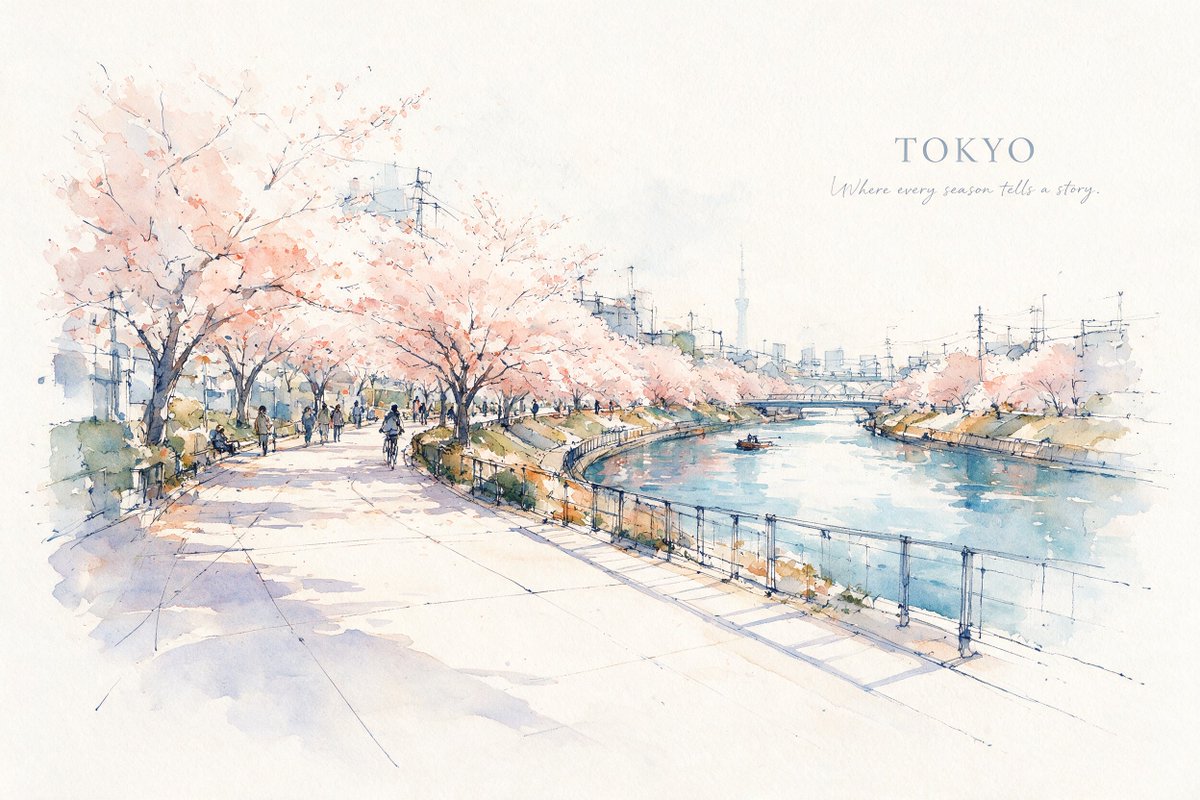
Create a refined horizontal aquarelle urban sketch of a peaceful, iconic outdoor location in [PLACE], [CITY], using delicate freehand ink, restrained transparent watercolor, and generous areas of warm-white cold-pressed paper.

COMPOSITION:
Use a landscape 3:2 composition viewed from natural pedestrian eye level. Place the defining feature of [PLACE] across the left and center-left middle ground. Let the street, promenade, square, riverbank, or pathway recede naturally toward an off-center vanishing point on the right.

Keep the immediate foreground spacious and pale. Show only a broad section of pavement, ground, or walkway with a few thin perspective lines and diluted lavender-blue shadows. Do not place oversized, cropped, or close-up people, trees, benches, furniture, vehicles, or objects against the front edge.

PERSPECTIVE:
Let paving joints, curbs, railings, pathways, and surrounding architecture converge naturally toward the distance. Reduce the size and spacing of pedestrians, bicycles, vehicles, trees, and buildings with distance. Maintain believable perspective while preserving slight freehand irregularity.

MIDDLE GROUND:
Make [PLACE] the primary focal area. Include a few relaxed pedestrians, subtle local details, and everyday elements that naturally belong to the location while keeping every figure and object proportionate to the surrounding architecture and landscape.

Use fine blue-black fountain-pen lines with changing pressure, broken contours, searching construction marks, and limited cross-hatching. Concentrate the clearest drawing around the central focal area without creating heavy black outlines.

COLOR:
Use transparent warm ochre, pale terracotta, muted coral, dusty sage, cerulean blue, and soft lavender-gray. Adapt the palette subtly to reflect the atmosphere of [CITY] while keeping the watercolor density light to medium. Reserve darker pigment for only a few small shaded areas.

Allow watercolor washes to form subtle blooms, uneven deposits, and dry edges. Use pale blue-violet washes for cast shadows. Let portions of architecture, foliage, clothing, sky, and surrounding details remain entirely unpainted.

BACKGROUND:
Suggest the surrounding skyline and landscape using thin interrupted lines and highly diluted blue-gray washes. If appropriate, include one recognizable landmark only as a small, distant, softly rendered silhouette naturally integrated into the composition. Do not turn the illustration into a landmark collage.

WHITE SPACE:
Preserve approximately 45% of the cold-pressed paper. Keep much of the foreground, upper sky, distant background, and one side of the composition lightly painted or entirely unpainted.

TYPOGRAPHY:
Reserve a quiet area of warm-white paper in the upper-right corner. Add the exact city name:

"[CITY]"

Set it in refined uppercase editorial lettering in muted blue-gray. Directly beneath it, add a short handwritten poetic tagline related to the city's atmosphere.

Keep the typography crisp, correctly spelled, and unobstructed by architecture, trees, or other objects.

The strongest detail and color should remain in the middle-ground focal area. The foreground must stay light, open, and secondary. No oversized foreground objects, no dramatic close-up elements, no dense silhouettes, no crowded tourist scenes, no landmark collage, no uniform color filter, no glossy digital watercolor, no CGI.