{
"type": "image_prompt",
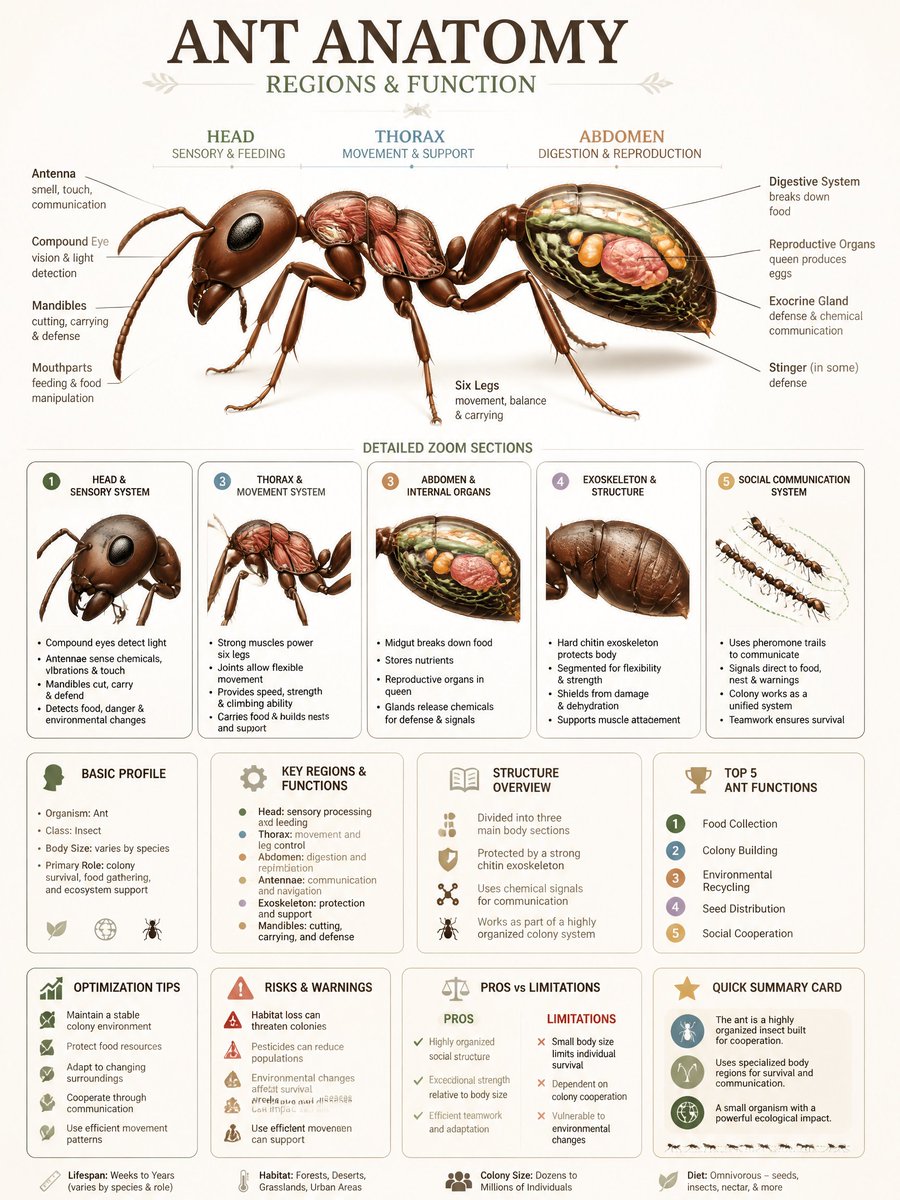
"title": "Ant Anatomy Regions & Function",
"style": {
"overall": "premium natural-history guidebook meets modern editorial infographic",
"tone": "educational, refined, collectible, highly structured",
"background": "clean light-colored",
"palette": "soft, elegant, muted scientific tones (earth browns, warm grays, subtle greens, gentle blues)",
"lighting": "gentle shadows, soft highlights",
"layout": "vertical, modular, high information density but uncluttered"
},
"composition": {
"main_subject": {
"type": "detailed anatomical illustration",
"description": "highly detailed ant with clearly defined body segments, internal organs, legs, antennae, and biological structures",
"style": "semi-realistic scientific illustration with soft shading",
"placement": "upper-middle focal area",
"labels": "major ant regions labeled with fine callouts"
},
"zoom_sections": [
{
"focus": "head and sensory system",
"description": "zoomed-in panel showing compound eyes, antennae, mandibles, communication, and environmental sensing"
},
{
"focus": "thorax and movement system",
"description": "zoomed-in panel showing muscles, six legs, joints, and powerful movement mechanics"
},
{
"focus": "abdomen and internal organs",
"description": "zoomed-in panel showing digestive system, reproductive organs, and defensive functions"
},
{
"focus": "exoskeleton",
"description": "detailed view showing protective outer shell, body segments, and structural strength"
},
{
"focus": "social communication system",
"description": "panel showing pheromone trails, colony communication, and teamwork behavior"
}
],
"info_panels": [
{
"title": "Basic Profile",
"content": [
"Organism: Ant",
"Class: Insect",
"Body Size: varies by species",
"Primary Role: colony survival, food gathering, and ecosystem support"
]
},
{
"title": "Key Regions & Functions",
"content": [
"Head: sensory processing and feeding",
"Thorax: movement and leg control",
"Abdomen: digestion and reproduction",
"Antennae: communication and navigation",
"Exoskeleton: protection and support",
"Mandibles: cutting, carrying, and defense"
]
},
{
"title": "Structure Overview",
"content": [
"Divided into three main body sections",
"Protected by a strong chitin exoskeleton",
"Uses chemical signals for communication",
"Works as part of a highly organized colony system"
]
},
{
"title": "Top 5 Ant Functions",
"content": [
"Food Collection",
"Colony Building",
"Environmental Recycling",
"Seed Distribution",
"Social Cooperation"
],
"visual_style": "ranked list or icon-based scoring"
},
{
"title": "Optimization Tips",
"content": [
"Maintain a stable colony environment",
"Protect food resources",
"Adapt to changing surroundings",
"Cooperate through communication",
"Use efficient movement patterns"
]
},
{
"title": "Risks & Warnings",
"content": [
"Habitat loss can threaten colonies",
"Pesticides can reduce populations",
"Environmental changes affect survival",
"Predators and diseases can impact colonies"
]
},
{
"title": "Pros vs Limitations",
"content": {
"pros": [
"Highly organized social structure",
"Exceptional strength relative to body size",
"Efficient teamwork and adaptation"
],
"cons": [
"Small body size limits individual survival",
"Dependent on colony cooperation",
"Vulnerable to environmental changes"
]
}
},
{
"title": "Quick Summary Card",
"content": [
"The ant is a highly organized insect built for cooperation",
"Uses specialized body regions for survival and communication",
"A small organism with a powerful ecological impact"
],
"visual_style": "highlight box with icons"
}
]
},
"visual_elements": {
"icons": "small, refined, minimal scientific icons",
"boxes": "rounded corners with subtle borders",
"typography": {
"title": "large, elegant, high contrast",
"subheadings": "clear hierarchy",
"body": "clean, readable, compact"
},
"connectors": "thin lines linking labels to ant regions",
"decor": "subtle grid or editorial alignment guides"
},
"design_goals": [
"knowledge integration",
"modular information design",
"encyclopedia-style clarity",
"high readability",
"shareable infographic aesthetic",
"non-commercial, reference-style presentation"
]
}