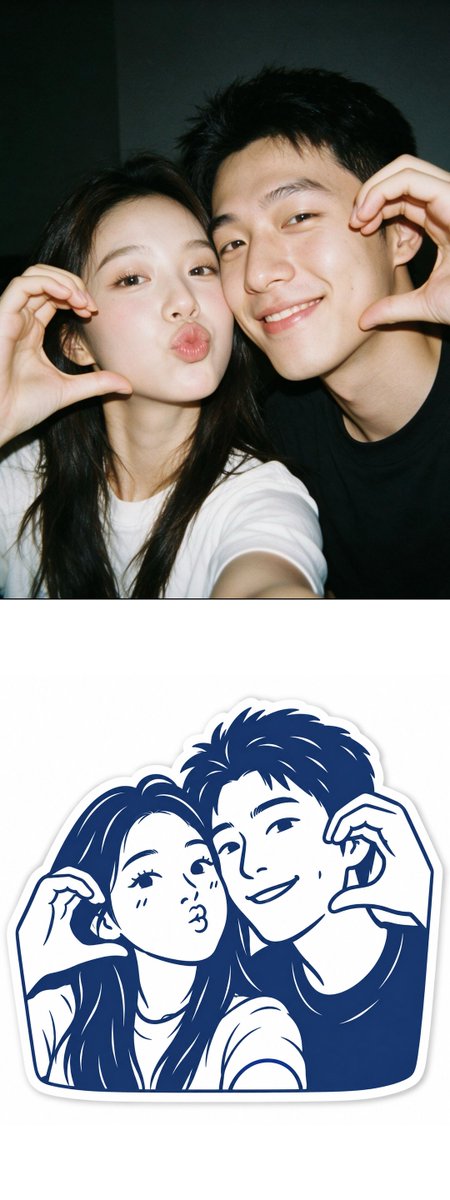
Transform the attached image into a minimal navy-and-white hand-drawn die-cut sticker illustration.

Treat the uploaded image as the sole source of content. First identify the primary subject or subjects. Support a single person, a single pet, two people, two pets, or one person with one pet. Preserve the exact number and type of primary subjects. Preserve their left-to-right order, relative scale, interaction, pose, gesture, head angle, gaze direction, expression category, clothing categories, worn accessories, and any object that is essential to the action or story. Preserve the source crop and viewpoint; if the source is a close-up, keep it a close-up. Never invent off-frame bodies, limbs, clothing, or scenery.

Create a recognizable but deliberately simplified character interpretation, not a traced portrait. Preserve identity through a small set of distinctive cues: face shape, hairstyle and silhouette, key accessories, characteristic expression, posture, and relationship between subjects. Do not reproduce pores, wrinkles, individual eyelashes, realistic eye anatomy, or photographic skin detail. For adults, use mild cartoon simplification only: slightly enlarged heads, moderately shortened torsos, and simplified limbs while clearly remaining adult. Avoid baby proportions, swollen cheeks, toddler bodies, oversized heads, or extreme chibi anatomy.

Use clean, friendly editorial doodle art with rounded, moderately thick, nearly uniform strokes and only slight hand-drawn variation. Outer contours may be slightly stronger than interior lines. Faces must be extremely economical: dot or short curved eyes, short brows, a one-stroke nose, and a simple mouth that retains the original expression. Render all outlines and dark fills in one deep navy blue, approximately #173B7A; never use pure black. Use white as the default fill. Convert clearly dark source areas such as dark hair or dark clothing into solid navy shapes, using only minimal white highlight cutouts when needed for readability. Keep human skin white and unshaded.

The default palette is strictly deep navy, white, and a very pale neutral-gray shadow. Do not introduce a third color unless the source contains at least two separate, clearly purple or lavender accessories or travel props that are narratively important; only then may those corresponding items use one flat muted lavender accent. Otherwise use no lavender and no additional color.

Remove the entire original environment. Remove architecture, landscape, ordinary furniture, floor texture, incidental objects, unrelated people, signage, interface marks, logos, captions, and watermarks. Place the simplified subject group alone on a clean, opaque white square canvas with generous margins. Wrap the complete group in one continuous wide white die-cut sticker border. Add a very subtle soft pale-gray shadow offset slightly down and right so the white border remains visible against the white canvas. No transparency.

Keep the original grouping and emotional relationship. Compress only empty space; do not change the narrative. Use a balanced centered composition, but keep asymmetry when it comes from the source. Include only the body parts visible in the source and retain the source framing. The finished image should feel like one cohesive sticker, not multiple separate stickers.

Avoid photorealism, line-art tracing, realistic portrait rendering, detailed anatomy, pencil or charcoal texture, watercolor, oil paint, anime or manga rendering, extreme chibi style, 3D rendering, gradients, glow, paper texture, grain, halftone, collage, complex lighting, detailed backgrounds, added props, altered subject count, duplicated limbs, malformed hands, text, captions, logos, signatures, and watermarks.

Return exactly one finished square sticker illustration.